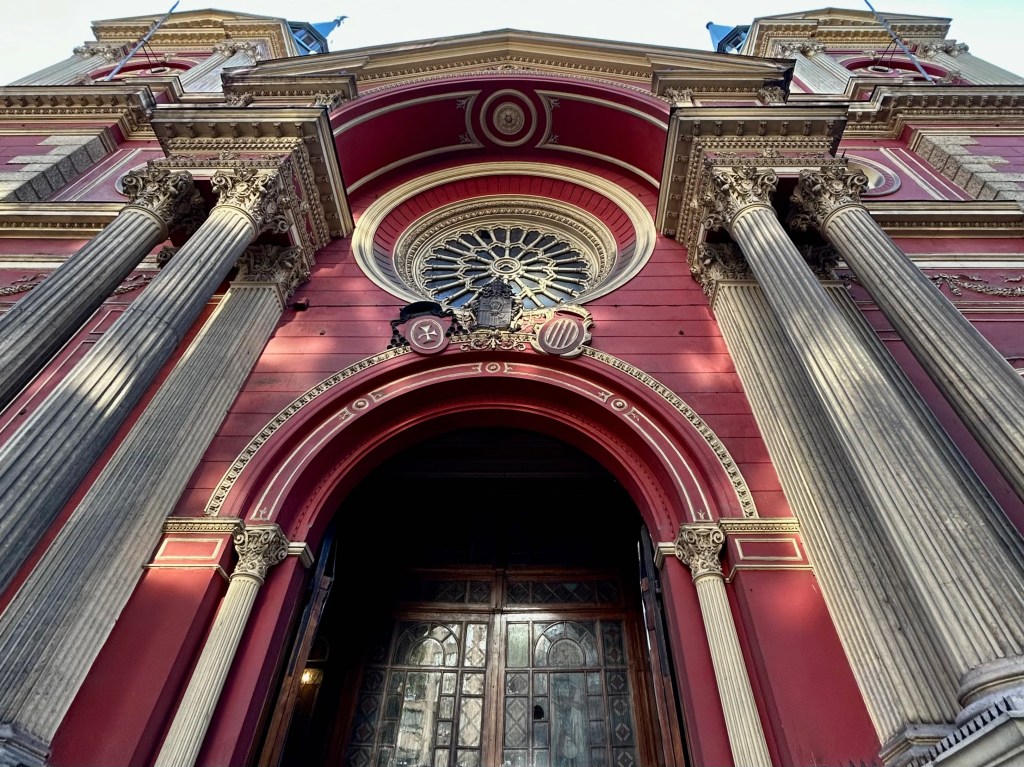
She stands outside a chapel
in Santiago.
Graffiti lives on the walls
behind the people selling goods in tents.
Fire trucks are lined up;
dogs are barking,
horns are screaming,
tires are screeching.
The city lives in chaos.
But when she walks past it all,
through the chapel doors,
she is suddenly the only one there.
Quietness and stillness
fill the moist church air.
The chapel looks the same as it did three hundred years ago:
pink stone,
arched vault,
Corinthian columns,
statues of saints along the aisles,
the priest’s booth covered with cherubs,
the pews slippery from years of wear,
a skylight shines down on the figure at the altar
who appears to be a woman
with long brown hair and white robes.
Her name is Mercy.
She walks down the center aisle
and immediately starts to cry.
Is she a somber person?
Does she want to cry?
Does she feel she has to suffer?
A chapel can sometimes make her feel that way.
One who enters a chapel
may feel as though they need to confess their “sins”
and pray things will get better
than what already is.
How disembodying, disempowering, capitalistic,
to make one feel that they are not at peace,
accepted,
or that they belong here, in the chapel,
just as they are.
She sees the faces of the frescos,
who are all sad, like her.
Her somberness is not unique.
All of us feel
and have felt like her
and the frescoes
for thousands of years.
The chapel is where we admit our existentialism.
She can show her emotions.
She can cry,
and it’s okay.
She can laugh and smile,
and it’s even better.
Because the chapel is dedicated to that,
to the ineffable,
to what we feel and cannot understand.
Places of spirituality are the only areas in modern society
where humans admit that they are not in control.
They’re the only spaces dedicated to letting go,
having faith,
and trusting in something other than our thinking mind.
They’re the only places to do all the things
we are told not to do in a city:
cry, sing, believe, question, imagine.
By simply stepping inside the chapel,
she gives a middle finger back to the city behind her.
Chapels are built to comfort our inevitable tragedies,
and the fact that the chapel — the church — has single-handedly
captured and brainwashed the majority of the minds of the world,
means we,
the human race,
must feel really tragic.
Although she cries,
she feels as though she is her childhood self again,
lying in bed, talking to “God,”
a presence that was accepting
and who always trusted in her.
She feels that she can finally trust again.
She feels that she finally belongs.
And she can sit in this pew forever,
or at least until the doors close.
 Ali Walks Around